
AI for Everyone: How Do We Know If an AI Really Works? (Part 6)
From hallucinations to human feedback, discover how to assess whether an AI really works well. Sixth and final part of our guide that makes …

From hallucinations to human feedback, discover how to assess whether an AI really works well. Sixth and final part of our guide that makes …

From quantization to model compression, discover how to make AI models more efficient and lightweight, explained through culinary and …
From Chain of Thought to RAG, discover how AI learns to think and reason through practical examples and everyday analogies. Part four of our …

From neural networks to attention mechanisms, discover how the ‘brain’ of AI works through simple and fun analogies. Part three …

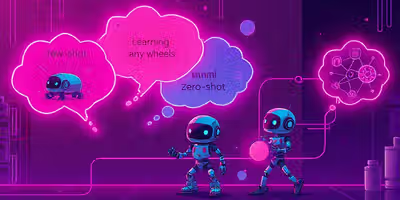
A fun journey through the different ways machines learn, explained with everyday analogies: from a bike with training wheels to training a …

From Large Language Models to Prompt Engineering, discover the fundamental concepts of AI explained in a simple and fun way, starting from a …

How to use Claude 3.5 to build machine learning models: from data analysis to production deployment

How to use Claude 3.5 to identify and fix performance problems in your code: real conversations, practical examples and measurable results

How to get the most out of pair programming with Claude 3.5: dialogue and collaboration techniques for working with AI

How to use Claude 3.5 to speed up web development: from building responsive components to debugging RESTful APIs

Claude Sonnet 3.5 and the Pair Programming Revolution: from the new 2025 features to advanced collaboration techniques with …

A semi-serious look at the surprising similarities between croissants, software development and hacking, with a dusting of powdered sugar …